HUN-REN ATOMKI
Space Chemistry
Research Group
Astrophysics
Astrochemistry
Materials Science for Space
Mission
Humanity is entering an exciting era of space exploration and exploitation in which we will conduct an exploration programme of the planets and moons in and beyond our own Solar System, as well as establishin a permanent presence of humans in space, such as on lunar bases or platforms in Earth and lunar orbit.
Compared to the terrestrial surface, space represents a hostile environment characterised by a wide range of temperatures, extreme vacuum conditions, and an active radiation environment; all of which influence the physical processes that occur there. This requires a new understanding (and, often, reinterpretation) of many basic physical phenomena, which to date have been assessed and defined purely in a terrestrial context.
The mission of the HUN-REN ATOMKI Space Chemistry Research Group is to conduct world-leading research to gain an understanding of the natural processes which determine chemical evolution in the molecular clouds of deep space and on the celestial bodies of planetary systems.
We also support space missions by studying the radiation effects on materials relevant to satellite technology and future Lunar and Martian settlements, as well as the functional changes in space-borne materials that support space exploitation.
The ATOMKI Solar-Wind Simulator
Among the processes which determine the chemical evolution in the molecular clouds of deep space and on the celestial bodies of planetary systems are those induced by radiation. At ATOMKI we model ion impact processes on icy and other solar system relevant surfaces using our SOlar-Wind Simulator (SOWS).
The Sun emits a stream of charged particles known as the solar (or stellar) wind. Most of them are protons and electrons, but heavier ions also make a significant contribution to it. In the figure, the energy spectra of those heavier ions are shown, measured by NASA satellites. The proton spectrum is not shown, but it is about one order of magnitude more intense than that of helium.
SOWS is composed of simulation chambers attached to one of ATOMKI’s accelerators. ICA at the Tandetron, and AQUILA at the ECR ion source. The grey inset in the figure shows the energy ranges covered by the particle accelerators. We are currently planning to replace our old high voltage platform with a mid-energy range accelerator (MERA). It will be equipped with two astrochemistry stations, one of them at the end of a vertical beamline for irradiating, e.g., powder samples, like Lunar regolith analogues.

Experimental Facilities
ICE CHAMBER FOR ASTROPHYSICS / ASTROCHEMISTRY (ICA)

The ICA experimental setup at Atomki is designed to investigate the ion irradiation of interstellar and Solar System ice analogues, deposited on a series of cold substrates. Ions of different species and charge states are produced by the Atomki Tandetron accelerator and may be used to mimic the effect of galactic cosmic rays and stellar winds. The ice composition and the physico-chemical changes induced upon ion irradiation are monitored by infrared spectroscopy. Temperature programed desorption studies may also be performed on both non-irradiated and irradiated ices. The goal of the experimental apparatus is to systematically study space relevant ices under different ion-impact conditions to better understand the origin and evolution of the building blocks of life.
ATOMKI-QUEENS UNIVERSITY ICE CHAMBER FOR LABORATORY ASTROCHEMISTRY (AQUILA)

The AQUILA facility is established to perform ion irradiation studies of astrophysical ice analogues. It consists of a UHV-compatible chamber containing a substrate on which astrophysical ice analogues can be grown at cryogenic temperatures (≥20K). Such ices can then be processed via ion irradiation. The ECRIS Laboratory can produce all known components of the solar wind, along with highly charged ions and certain negative or molecular ions. The resultant chemical or physical changes in the ice may be monitored using mid-infrared spectroscopy. Temperature programed desorption studies may also be performed. The goal of the experimental apparatus is to systematically study space relevant ices under different ion-impact conditions.
FACILITY FOR REFRACTIVE OPTICS DENSITY AND SPUTTERING TESTS (FROST)
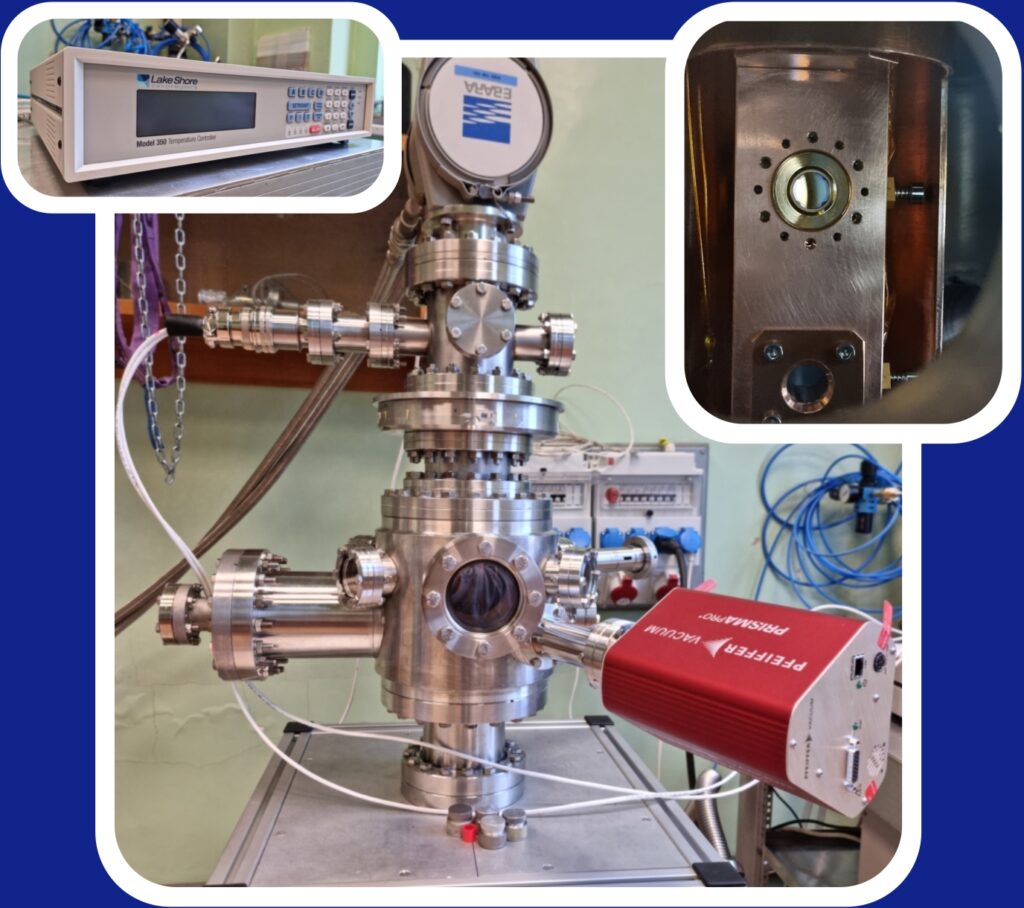
This setup investigates the optical and physical properties of ices relevant to astrochemistry and molecular astrophysics. It consists of a UHV chamber with a cryogenic sample holder, a two-laser interferometry system, and a cryogenic quartz-crystal microbalance (CQCM). The laser system dynamically measures ice thickness and refractive index during deposition, while the CQCM directly determines the deposited mass, allowing the ice density to be calculated. By varying the substrate temperature and deposition rate, the setup can provide information on ice phase transitions and potentially ice porosity. As the chamber is currently under construction, further details on its performance and availability will be provided in the near future.
TIME OF FLIGHT FACILITY FOR EXTRATERRESTIAL LIKE EXPERIMENTS (TOFFEE)

TOFFEE is a specialized Time-of-Flight spectrometer for studying ion-induced molecular fragmentation. It is based on a Wiley-McLaren setup, enhanced with an electrostatic extractor and an einzel lens system. Projectile ions from H⁺ to S⁺ are generated by the Atomki Tandetron accelerator and used in a standard crossed-beam arrangement. After collisions, charged fragments are extracted and directed through a drift tube to a custom-made MCP detector, which records their flight times and approximate impact positions. The experiments aim to systematically investigate the irradiation-induced dissociation of space-relevant molecules and provide molecular-level insight into ice-phase processes.
FIELD FREE TIME OF FLIGHT (FFTOF)
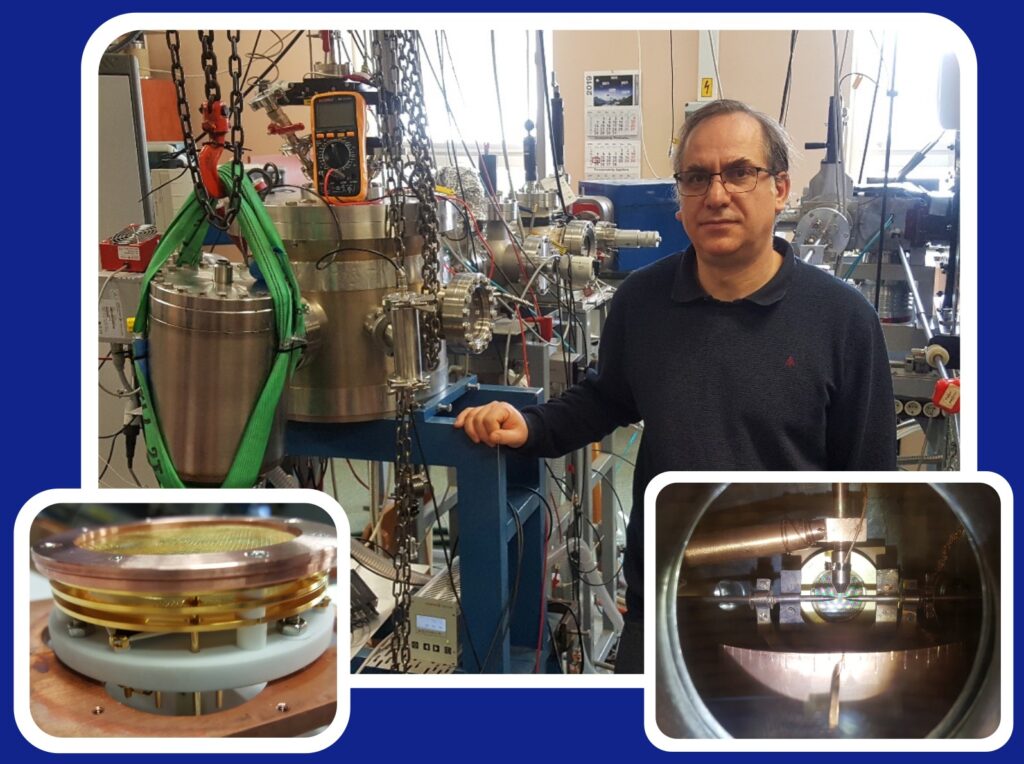
The Experimental Molecular Physics Research Group (formerly the Section of Atomic Collisions) at ATOMKI has long investigated molecular fragmentation induced by ion impact. Earlier experiments used electric or magnetic fields to separate fragment ions and measure their energy spectra in biologically and astrophysically relevant molecules such as H₂, H₂O, CH₄, CO, and C₆H₆, typically in the 2–2000 eV range. However, most fragments have energies below 2 eV, which were difficult to measure reliably due to field-induced disturbances. To overcome this limitation, a new setup was developed from 2018 to measure fragment-ion energies and angular distributions down to 0.1 eV by minimizing external fields and recording the time-of-flight of freely moving ions with a position-sensitive MCP detector.
Projects and Networking
Firmly integrated into regional, European, and global networks of international space science collaboration, ATOMKI and its Space Chemistry Research Group actively contribute as a member of the Europlanet Society and serve as the driving force behind the Hungarian Space Chemistry Research Network. In alignment with the European states’ commitment to advancing space research—recognized for its scientific and technological value to the European economy—we are dedicated to establishing ATOMKI’s laboratories as a world-class research hub. This vision is pursued through close cooperation with our international partners, ensuring a leading role in this rapidly evolving field.
Recent publications
An interstellar energetic and non-aqueous pathway to peptide formation
Alfred Thomas Hopkinson, Ann Mary Wilson, Joe Pitfield, Alejandra Traspas Muiña, Richárd Rácz, Duncan V. Mifsud, Péter Herczku, Gergö Lakatos, Béla Sulik, Zoltán Juhász, Sándor Biri, Robert W. McCullough, Nigel J. Mason, Carsten Scavenius, Liv Hornekær, Sergio Ioppolo
Abstract
The origin of the molecular building blocks of life is a central question in science. A few α-amino acids, such as glycine, the simplest proteinogenic amino acid, have been detected in meteorites and comets, indicating an extraterrestrial origin for some prebiotic molecules. However, the formation of peptides, short chains of α-amino acids linked by peptide bonds, has remained unresolved under astrophysical conditions. Here we show that the building blocks of proteins can form in interstellar ice analogues exposed to ionizing radiation without the presence of liquid water. Using isotopically labelled glycine irradiated with protons at cryogenic temperatures, we detect the formation of glycylglycine, the simplest dipeptide, along with deuterated and undeuterated water as by-products. The formation of peptide bonds is confirmed by infrared spectroscopy and high-resolution mass spectrometry, which also reveal the production of other complex organic species. These findings demonstrate a non-aqueous route to peptide formation under space-like conditions and suggest that such molecules could form in the cold interstellar medium and be incorporated into forming planetary systems. Our results challenge aqueous-centric models of early biochemical evolution and broaden potential settings for the origins of life.
Irradiation of methanol ice on a sulfur-rich dust analogue at 25 K: a mid-infrared spectroscopic study
D. V. Mifsud; Z. Kaňuchová; O. Auriacombe; P. Herczku; R. Rácz; S. T. S. Kovács; D. Qasim; B. Sulik; Z. Juhász; I. Vajda; I. Rajta; U. Raut; S. Biri; S. Ioppolo; N. J. Mason
Abstract
Despite possibly representing a comparatively large reservoir of sulfur in extraterrestrial environments, the role of sulfur allotropes in the radiation-driven chemistry occurring in low-temperature ices in astrophysical media (e.g., pre-stellar nebulae or the outer Solar System) is an underexplored topic. Previous work has shown that the irradiation of astrophysical ice analogues composed of simple molecules on top of layers of allotropic sulfur results in the formation of simple, inorganic sulfur-bearing molecules in the ice phase. Our present work seeks to qualitatively determine whether the analogous irradiation of methanol on top of allotropic sulfur may lead to the formation of organosulfur molecules, as well as H2S. Using in situ mid-infrared absorption spectroscopy, we have found compelling evidence for the formation of SO2, CS2, H2SO4, and a number of sulfur oxyanions, as well as tentative evidence for H2S formation. Evidence for the formation of thiol molecules was inconclusive. Our experimental results are discussed in the context of their applicability to sulfur astrochemistry.
Infrared spectral signatures of nucleobases in interstellar ices II: Pyrimidines
Caroline Antunes Rosa, Alexandre Bergantini, Péter Herczku, Duncan V. Mifsud, Gergő Lakatos, Sándor T.S. Kovács, Béla Sulik, Zoltán Juhász, Sergio Ioppolo, Nigel J. Mason, Claudia Lage
Abstract
The identification of pyrimidine nucleobases in interstellar environments such as dense clouds and pre-stellar cores represents a much sought-after result in astrochemical and astrobiological research. Indeed, such an identification would allow for insights into the interstellar formation of these complex organic molecules and, possibly, a better understanding of their putative transfer to the early Earth where they may have contributed to the emergence of life. In this present work, we report the results of an extensive mid-infrared spectroscopic study of the solid pyrimidine nucleobases cytosine, thymine, and uracil under conditions representative of the dense interstellar medium to potentially facilitate their identification in such environments. Spectra of the neat crystalline nucleobases, as well as a mixture of all three, were acquired at temperatures of 300 and 20 K. Furthermore, the spectra of these nucleobases in the presence of interstellar ice analogues containing H2O:NH3:CH4:CO:CH3OH in a 10:1:1:1:1 ratio were also acquired to determine whether any nucleobase absorption features were evident in the presence of ubiquitous volatile interstellar molecular ices, and thus could be used as possible spectroscopic fingerprints for the identification of interstellar pyrimidines. Our present work has identified three mid-infrared absorption bands at 1512, 1237, and 758 cm–1 (6.61, 8.08, and 13.19 μm) that could be useful in this regard. The potential utility of these absorption features in observational surveys of the dense interstellar medium, together with the limitations of our study and recommendations for future work, are discussed in detail.